Bigger pieces
Considering just the base pieces without a border, we see 17 different sides in use. This allows for approximately 75000 unique pieces. The puzzle only has 192 inner pieces. 192 out of 75000 means there is potentially a lot to gain to pre-calculate bigger pieces with valid inner side combinations. A first estimate was 1 million 2x2 pieces.
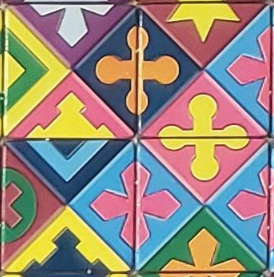
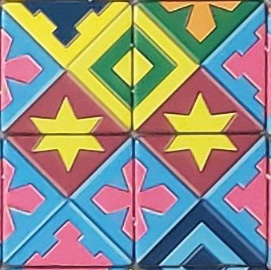
The 2x2 pieces generator considers the following special cases:
- Hint pieces (5x) must be in a specific location in the 2x2 and never together in the same 2x2.
- Corner piece must be combined with 2 border pieces and one inner piece that is never a hint.
- Borders pieces always in pairs on at most one of the sides (never in the middle) combined with 2 inner pieces
Since the pieces do not have a predefined “up” direction, each piece can be placed under 4 possible rotations. I considered the option to pre-generate all rotation variants of the 2x2 pieces, mainly to avoid rotating the corners, borders and hints into invalid positions on the board. This approximately quadruples the number of 2x2 pieces generated, but trades work in the solvers versus handling some more rows in a database table. I decided for it.
This resulted in a total of 3.95 million 2x2 pieces.
A 2x2 piece stores information about the 4 base pieces it is based on, including their respective rotations. The fields are named nr1, nr2, nr3, nr4 and rot1, rot2, rot3, rot4.
To search for a piece that does not need one of the base pieces already in use on the board:
qset = Piece2x2.objects.exclude(nr1__in=used_pieces)
                       .exclude(nr2__in=used_pieces)
                       .exclude(nr3__in=used_pieces)
                       .exclude(nr4__in=used_pieces)
I also tried creating 3x3 pieces, but the number of possible pieces is simply too much (trillions).