Manually solving from ring1
The image below shows a ring1 loaded into a board. Several 3x3 evaluators (eval_loc_9) are at work to reduce the remaining options.
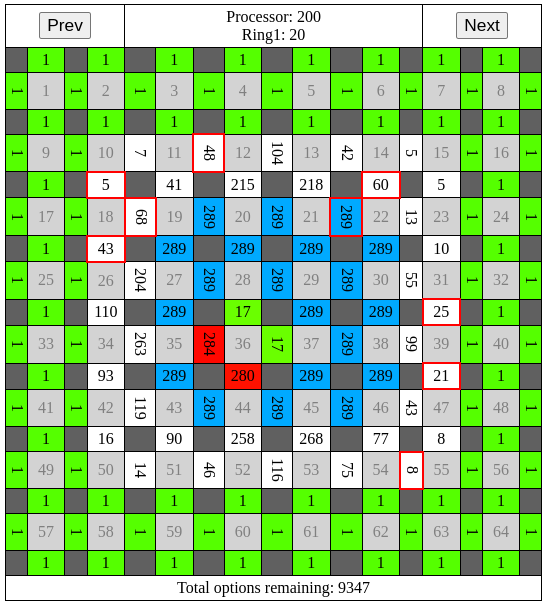
Approximately 20 minutes later it looks like this:
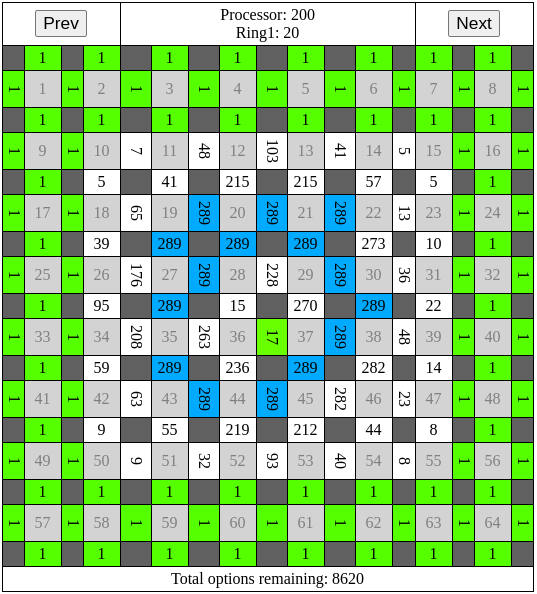
How would you continue?
- Fix the center hint? Location 36 has 1857 pieces to chose from
- Fix the other four hints? Locations 10, 15, 50, 55 respectively have 7, 5, 11 and 8 pieces to chose from
- Fix some of the segments? Will you chose a high or low number?
- The right side seems to have fewer options.
- Looking at the claims: location 10 has 2 claims
Let’s try location 15
Try location 15 option 2
$ dup 200 201
[INFO] Duplicating processor 200 to 201
[INFO] Creating 8620 records
$ fix 201 15 2 --commit
[INFO] Processor=201; Location: 15
[INFO] 117 base pieces in use or claimed
[INFO] Selecting 2 / 5
[INFO] Performing eval_loc_1 equivalent check for loc 15
[INFO] Selected p2x2 with base nrs: [109, 255, 83, 215]
[INFO] Side 1 is segment 15
[INFO] Side 2 is segment 116
[INFO] Side 3 is segment 23
[INFO] Side 4 is segment 115
[INFO] Reductions: 0, 0, 4, 4
$
(the commands used are shell aliases for the commands shown earlier)
- Selection 1: dead-end in location 47.
- Selection 2: dead-end in location 47.
- Selection 3: stable with 6373 options remaining. Tension in locations 50 (2 pieces remaining) and 47 (3 pieces remaining).
- Selection 4: solves locations 55, 47, 39 but dead-ends in the bottom row (locations 50, 51, 52, 53)
- Selection 5: stable with 6754 options remaining. Location 23 has 3 pieces remaining.
Let’s duplicate the last board and work with location 23.
- Selection 1: stable with 5742 options remaining.
- Selection 2: stable with 5903 options remaining.
- Selection 3: stable with 5671 options remaining.
All three boards have tension in the right column (locations 31, 39, 47, 55). Location 31 only has 3 to 4 pieces remaining. Locations 10, 50 and 55 only have 5 pieces remaining.
Let’s duplicate the board with the most options and work with location 31.
- Selection 1: dead-end in location 11 after solving locations 31, 39, 47, 55, 14, 13, 12.
- Selection 2: dead-end in location 12 after solving locations 31, 39, 47, 55, 54, 53, 52, 51.
- Selection 3: dead-end in location 11 after solving locations 31, 39, 47, 55, 14, 13, 12.
- Selection 4: dead-end in location 50 after solving locations 31, 39, 47, 55, 54, 53, 52, 51.
Let’s duplicate the board with the fewest options and work with location 31.
- Selection 1: dead-end in location 46 after solving locations 31, 39, 47, 55, 54.
- Selection 2: dead-end in location 44 after solving locations 31, 39, 47, 55, 54, 53, 52, 51, 50, 42.
- Selection 3: dead-end in location 12 after solving locations 31, 54, 10, 18.
And the last option:
- Selection 1: dead-end in location 14 after solving 31, 39, 47, 55, 54, 53, 52.
- Selection 2: dead-end in location 47 after solving 31, 39, 55.
- Selection 3: dead-end in location 14 after solving 31, 39, 47, 55.
Location 14 does not have claims, but is running out of 2x2 options probably because of the used base pieces.
$ ./manage.sh eval_loc_1 252 14
[INFO] Location: 14; processor=252
[INFO] 148 base pieces in use or claimed
[INFO] Side options: 1, 1, 6, 10
[INFO] Number of Piece2x2: 0
Everything is dead end, so we need to take the next option for location 15.
Try location 15 option 3
Option 3 was a quick dead-end after immediately solving the right column and reducing the total option to below 4000, which is typically a bad sign.
Trying option 4 for location 15 instead.
Try location 15 option 4
After the initial propagation “scan1” was done to touch all locations and a “scan9” to evaluate 3x3 on 20 positions. Since the board did not run into a dead-end, a “line2” evaluator was used on each side followed by a 4x4 evaluation in 4 position.
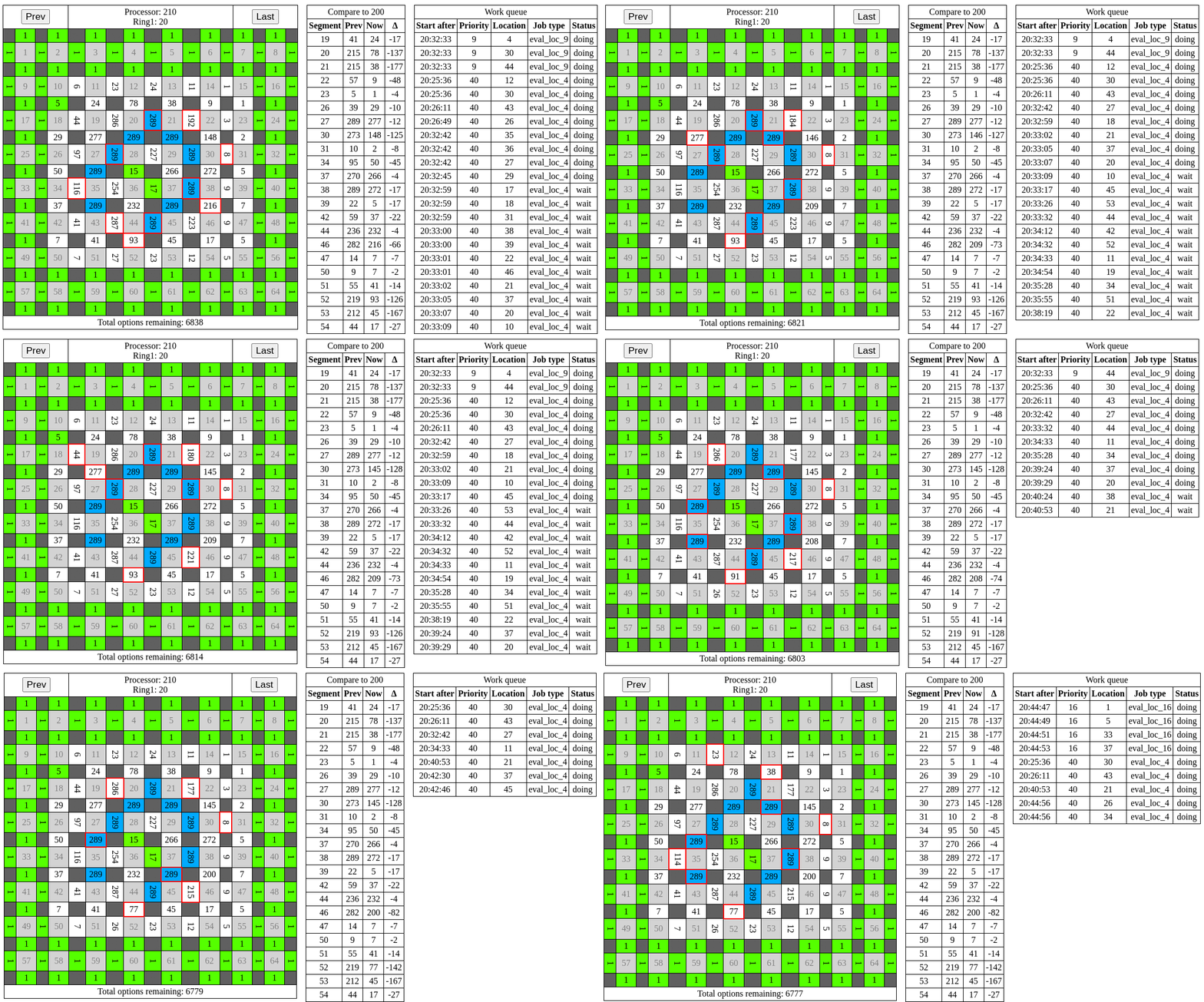
The intermediate result has 6220 options left, with 6, 3, 8 and 5 pieces possible in location 10, 23, 50 and 55. Let’s duplicate the board three times and fix location 23 to a different option on each board.
$ dup 210 211
$ dup 210 212
$ dup 210 213
$ fix 211 23 0 --commit
$ fix 212 23 1 --commit
$ fix 213 23 2 --commit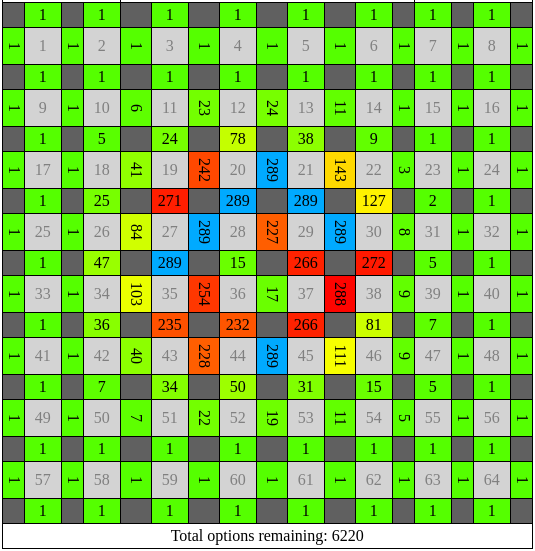
Add scanning with 1x1 at prio 2 and 3x3 at prio 9 all over the board:
$ ./manage.sh add_work 211 scan1 2 2
$ ./manage.sh add_work 212 scan1 2 2
$ ./manage.sh add_work 213 scan1 2 2
$ ./manage.sh add_work 211 scan9 9 9 --limit=289
$ ./manage.sh add_work 212 scan9 9 9 --limit=289
$ ./manage.sh add_work 213 scan9 9 9 --limit=289
All try survive with 4497, 5484 and 5315 options left. Locations 31 as well as location 55 have 3, 4, 4 options left.
All 11 boards run into dead-ends. Two examples are shown below.
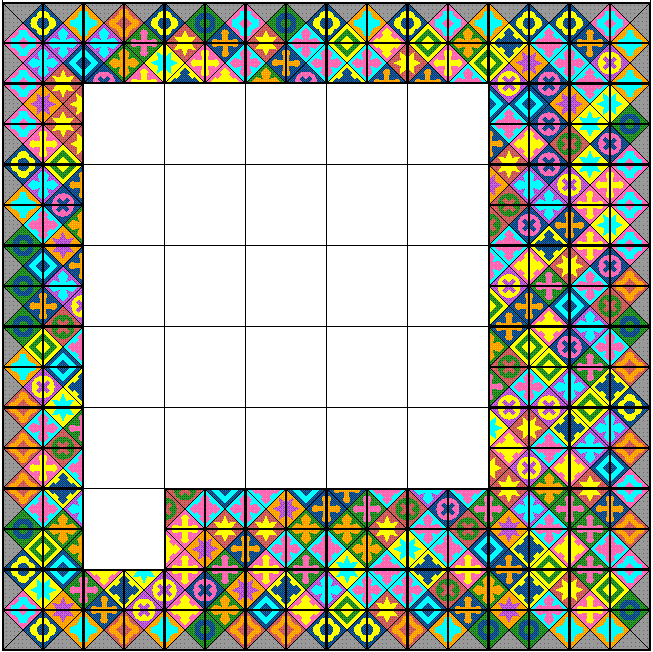
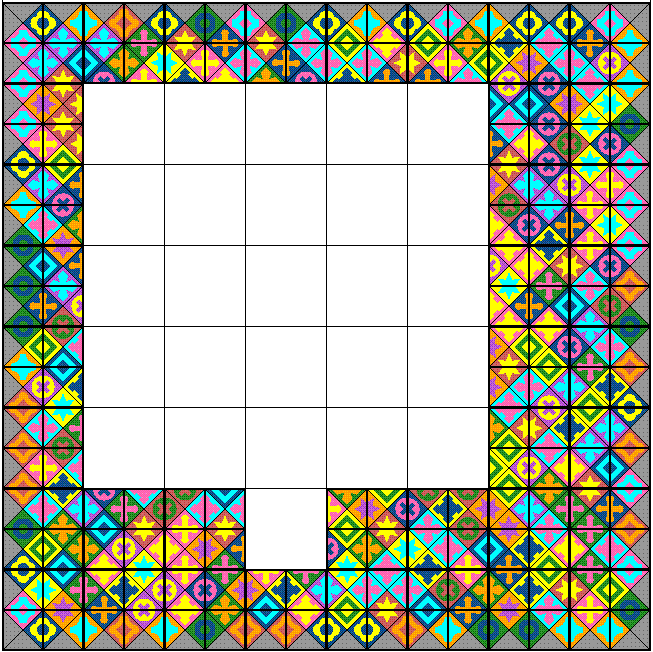
These boards show that a 3-side fit is the most challenging.
The inside-out strategy should therefore be more successful.